IMF and Pakistan Reach Staff-Level Agreement for $1.2 Billion Payout to Support Economy

Introduction & Recent Development
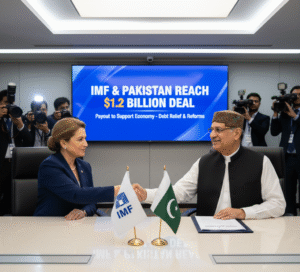
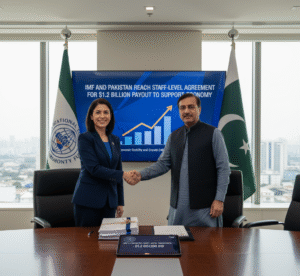
In October 2025, Pakistan and the International Monetary Fund (IMF) reached a staff-level agreement that would permit a $1.2 billion disbursement, contingent on approval by the IMF Executive Board. Of this amount, $1.0 billion is allocated under the Extended Fund Facility (EFF) and $200 million under the Resilience & Sustainability Facility (RSF).
This agreement is viewed as a crucial lifeline for Pakistan’s fragile economy. The inflow aims to support foreign reserves, stabilize the external sector, enable budgetary breathing room, and underpin reform momentum. The IMF, in its public statements, noted that Pakistan’s recovery is “on track,” citing improved buffers, contained inflation pressures, and stronger fiscal discipline. Meanwhile, the Pakistani government has outlined plans to re-enter global capital markets via a green yuan-denominated bond and a future international dollar bond. IMF and Pakistan Staff-Level Agreement $1.2 Billion Payout IMF Pakistan 1.2 billion payout, Pakistan IMF staff-level agreement, IMF EFF RSF Pakistan, Pakistan economy IMF deal.
However, reaching a staff-level agreement is still an interim stage. The disbursement is not guaranteed until the IMF Executive Board gives formal approval, and Pakistan adheres to the agreed conditions, benchmarks, and structural reforms.
This article provides in-depth analysis of the agreement, its background, terms, risks, and what it could mean for Pakistan’s economy going forward — aligned with the principles of expertise, authoritativeness, and transparency.
What Is a Staff-Level Agreement (SLA) in IMF Terms?
In IMF program parlance, a staff-level agreement represents the point when IMF staff and a country’s authorities agree in principle on the financial, structural, and conditionality terms of a review or disbursement. Key points:
-
The staff team, after its mission, negotiates with government officials on macro targets, structural benchmarks, conditionality, and prior actions.
-
Once both sides agree, that becomes the staff-level agreement (SLA).
-
The next step is approval by the IMF Executive Board, which reviews the staff report, may seek clarifications, and then formally authorizes the disbursement.
-
Only after board approval — not at the SLA stage — are funds released.
Thus, while the SLA is a critical signal (markets respond, policy decisions follow), it is not the final legal release of funds.
Historical Context: Pakistan’s Engagement with the IMF
To appreciate the significance of this agreement, we need to look back at Pakistan’s history with IMF programs and economic crises.
Multiple IMF Programs over Decades
Pakistan has turned to the IMF many times over its history, especially during stress episodes of balance-of-payments pressure, fiscal deficits, or external debt strain. In recent decades:
-
Pakistan has been under IMF programs multiple times, often involving structural adjustment, fiscal consolidation, and external support.
-
In June 2023, Pakistan struck a staff-level agreement for a $3 billion stand-by arrangement.
-
In July 2024, Pakistan and the IMF agreed a broader $7 billion package combining EFF and RSF, to be disbursed over roughly 37 months.
Thus, the current $1.2 billion agreement should be viewed as part of the ongoing 2024 program, not an entirely new standalone program.
The 2022–2024 Economic Crisis
Between 2022 and 2024, Pakistan’s economy endured a confluence of adverse shocks:
-
Global commodity and energy price spikes
-
A large external financing gap
-
Rapid inflation (reaching ~30-40 % year-on-year)
-
Weak foreign exchange reserves
-
Heavy debt servicing burdens
-
Recurrent climate shocks (notably floods in 2022)
These pressures left Pakistan on the edge of a default scenario and necessitated renewed reliance on external institutions like the IMF for stabilization support.
Challenges with Past Programs
Earlier IMF programs in Pakistan often faced:
-
Delays in reviews or disbursements due to unmet conditions
-
Resistance to austerity measures (tax hikes, subsidy cuts)
-
Weak compliance with structural reform benchmarks
-
Political instability undermining consistency of policy
This legacy imposes a higher burden of credibility now — both on the Pakistani leadership and the IMF.
The 2024 IMF Program: EFF + RSF Explained
The $1.2 billion payout is embedded in a broader 2024 IMF program combining the Extended Fund Facility (EFF) and Resilience & Sustainability Facility (RSF).
Extended Fund Facility (EFF)
The EFF is a more traditional IMF instrument for medium- to longer-term support under structural conditionality. Key features:
-
Multi-year program (for Pakistan, ~37 months)
-
Disbursements contingent on periodic reviews
-
Emphasis on macro stability, fiscal consolidation, structural reforms
The current SLA would unlock $1.0 billion under the EFF tranche.
Resilience & Sustainability Facility (RSF)
The RSF is a newer IMF facility aimed at helping countries enhance resilience to climate shocks, sustainability, and long-term adaptation. In context:
-
Pakistan’s 2024 program included an RSF component aimed at climate, disaster, and sustainability goals
-
Under the SLA, $200 million would become available under the RSF tranche
Thus, the $1.2 billion is split across the two facilities as part of the ongoing program’s second review.
Cumulative Disbursement Status
If approved, this tranche would bring total disbursements under the 2024 program to approximately $3.3 billion (considering prior approved tranches).
Negotiation Journey to the SLA
Reaching a staff-level agreement is rarely straightforward; Pakistan and the IMF staff engaged in multiple rounds of negotiation.
Mission Visits & Timeline
An IMF mission led by Iva Petrova visited Pakistan (Islamabad and Karachi) in late September and early October 2025. The mission evaluated Pakistan’s compliance with previous program conditions, performance on benchmarks, and readiness for the next disbursement.
Earlier attempts had not yielded a full agreement, prompting additional clarifications and follow-up. Eventually, remaining sticking points were resolved, enabling the public announcement of the SLA.
Key Negotiated Areas
During the negotiations, several major issues would have commanded attention:
-
Fiscal targets: ensuring that revenue and expenditure projections are credible and sustainable
-
Revenue mobilization: how aggressively the government will raise taxes or close loopholes
-
Energy sector reforms: addressing circular debt, tariff adjustments, and governance in power utilities
-
Structural reforms: reforming state-owned enterprises (SOEs), public financial management, privatization
-
Climate and disaster resilience measures: given Pakistan’s vulnerability to floods, the IMF likely pressed for credible resilience plans
-
Social protection safeguards: ensuring vulnerable populations are shielded from excessive burden
-
External buffers and reserves: possibly agreeing on reserve buildup targets and external sector stability
Some of the structural benchmarks tied to privatization (e.g. parts of the power sector, PIA) have been openly mentioned by the Pakistani authorities.
The IMF’s public statements emphasize that the authorities reaffirmed commitment to sound macro policies while advancing ongoing structural reforms, including those related to climate resilience.
Market Signals & External Pressure
Markets were watching closely. Pakistani sovereign spreads had narrowed leading up to the announcement, reflecting growing confidence as negotiations drew toward closure. The Pakistani finance minister had publicly predicted an imminent staff-level agreement, reinforcing expectations.
Core Terms & Conditions of the SLA
To understand how binding and consequential this agreement is, we must examine its contours: disbursement amounts, benchmarks, structural conditions, and flexibility clauses.
Disbursement Amounts
-
$1.0 billion under the EFF
-
$200 million under the RSF
-
These disbursements hinge on IMF Executive Board approval and compliance with agreed performance criteria
-
Total program disbursements would rise to approximately $3.3 billion upon approval of this tranche
Quantitative Benchmarks & Macroeconomic Targets
Pakistan will need to meet benchmarks such as:
-
Primary fiscal balance (or limits on deficit)
-
Revenue targets (tax and non-tax)
-
Debt-to-GDP trajectories
-
Inflation control (keeping inflation within a permissible range)
-
Foreign reserves targets or external buffer thresholds
-
Current account outcomes — maintaining a manageable deficit or surplus
Earlier reporting indicates that in FY25, Pakistan achieved a current account surplus (first in 14 years), surpassed its primary fiscal balance target, and showed control over inflation — a favorable backdrop for negotiation.
Structural Benchmarks & Prior Actions
These are non-discretionary reforms required at set dates, or prior to disbursement. Potential structural benchmarks include:
-
Reforming tax administration (FBR) — base broadening, digitization, enforcement
-
Improving public financial management (PFM) — budget transparency, tracking of expenditures
-
Energy sector reforms: reducing circular debt, ensuring cost-recovery tariffs, restructuring distribution companies
-
Privatization and governance reforms in SOEs (including power distribution companies, PIA)
-
Strengthening procurement systems, anti-corruption measures, regulatory reforms
-
Strengthening climate and disaster risk adaptation systems (early warning, infrastructure resilience)
-
Enhancing social protection systems (e.g. making BISP more effective and inclusive)
The government has publicly committed to privatizing three power distribution companies and PIA, which suggests these may be part of structural conditions.
Conditionality & Built-in Flexibility
While the IMF will enforce conditionality, there is often some flexibility for unforeseen shocks. In Pakistan’s case:
-
The IMF statements explicitly acknowledge recent flood damage and climate risks
-
The authorities retain limited flexibility to reallocate budget for flood relief
-
Adjustment clauses or waivers may apply if natural disasters or external shocks force deviations
Still, core obligations (benchmarks and targets) will be closely monitored.
Review Mechanism & Timing
-
This is the second review under the 2024 EFF program and the first under the RSF
-
Subsequent reviews likely follow at intervals (6 months or trimesters)
-
Disbursements may be phased across tranches, tied to compliance with upcoming benchmarks
Pakistan’s Economic Landscape: Strengths, Weaknesses & Risks
The broader impact of the disbursement depends heavily on Pakistan’s macro fundamentals and structural constraints.
Macroeconomic Indicators & Recent Trends
-
Pakistan’s nominal GDP is estimated around $350–370 billion
-
The FY25 current account recorded a surplus, a notable deviation after many years
-
Fiscal primary balance exceeded program targets
-
Inflation is described as being under control, though susceptibility remains
-
Foreign exchange reserves have been bolstered
-
Sovereign credit spreads have narrowed, signaling improved market sentiment
These positive developments provided a conducive environment for negotiation and agreement.
Structural Weaknesses & Ongoing Risks
Despite improvement in some indicators, structural impediments remain:
-
Heavy Debt Burden
Pakistan continues to face high levels of domestic and external debt, requiring large interest and amortization payments. -
Energy Sector Stress
The energy sector has long been burdened by inefficiencies, subsidies, and circular debt. Without genuine reform, it drains fiscal resources. -
Tax Base Deficiencies
The tax-to-GDP ratio remains low. Widespread exemptions, low compliance, and administrative weaknesses hamper revenue growth. -
Institutional Capacity & Governance
Implementation of reforms often lags due to weak institutions, corruption perception, and political interference. -
Political Instability & Policy Reversal Risk
Elections or political shifts can alter reform momentum or lead to rollback of commitments. -
Exposure to Climate & Disaster Shocks
Pakistan is highly vulnerable to floods, droughts, and extreme weather. Recent floods damaged crops and infrastructure, requiring reconstruction. -
External Shock Sensitivity
Global interest rates, commodity volatility, and capital flow reversals pose risks to the external sector.
Use of Funds & Transmission Channels
Once released, the $1.2 billion tranche can be deployed through several channels to support stabilization, growth, and resilience.
Reserve Support & External Stability
One of the primary functions will be to bolster foreign exchange reserves. Strong reserves help:
-
Support import payments
-
Meet external debt servicing
-
Stabilize the currency
-
Build market confidence
Budgetary & Fiscal Buffering
Some funds may be used as budgetary support, easing immediate fiscal pressure, cushioning adjustments, or enabling smoother debt payments.
Debt Service & Roll-over Support
Given significant upcoming maturities and liabilities, part of the funds may help manage external debt service, mitigating rollover or default risk.
Infrastructure & Reconstruction (Flood & Climate Projects)
Linking to its RSF component, funds may be earmarked for:
-
Reconstruction of damaged infrastructure
-
Restoration of farmland, roads, canals, bridges
-
Strengthening climate-resilient infrastructure (water systems, flood protection)
Social Safety Nets & Protection of Vulnerable Groups
To maintain social legitimacy, funds may help expand or reinforce social assistance (e.g. BISP), health, and education — ensuring that poverty, inequality, or hardship do not intensify under adjustment. IMF and Pakistan Staff-Level Agreement $1.2 Billion Payout IMF Pakistan 1.2 billion payout, Pakistan IMF staff-level agreement, IMF EFF RSF Pakistan, Pakistan economy IMF deal.
Facilitation of Reform Implementation
Some resources may support costs of reforms — capacity building, technical assistance, institutional enhancements, or transition costs of privatization.
Confidence & Market Signaling
Beyond direct uses, the disbursement has symbolic value. It signals to investors, credit rating agencies, and bilateral donors that Pakistan is committed to reform and stabilization. That may help Pakistan re-enter capital markets.
The finance minister has explicitly proposed issuing a green bond in Chinese yuan, followed by a $1 billion international bond as part of re-engaging global financial markets.
Reform Agenda: Core Areas & Challenges
The ability to deliver on reforms is the linchpin of success. Below are key priorities and constraints.
Tax & Revenue Reform
-
Broaden the tax base: reduce exemptions, rationalize preferential treatments
-
Strengthen tax administration (FBR): digitization, audits, anti-evasion measures
-
Improve compliance, transparency, and enforcement
-
Encourage provincial revenue generation and cooperation
These reforms are politically sensitive but necessary for sustainable fiscal consolidation.
Expenditure Rationalization & Efficiency
-
Trim wasteful spending and subsidies
-
Channel resources into priority sectors (education, health, infrastructure)
-
Strengthen public financial management, budget discipline, and expenditure controls
Energy & Power Sector Overhaul
-
Address circular debt systematically
-
Gradually move to cost-reflective tariffs
-
Privatize or restructure inefficient power distribution companies
-
Improve governance, reduce losses, and upgrade infrastructure
Given the persistent drag of power sector deficits, this is a centerpiece of fiscal reform.
SOE Reforms & Privatization
-
Accelerate privatization of loss-making state-owned enterprises (e.g. PIA, power distribution)
-
Improve management, governance, and transparency in remaining SOEs
-
Ensure that privatization proceeds are used prudently (e.g. for debt reduction or capital investment)
Institutional Strengthening & Governance
-
Reform procurement, contract management, and anti-corruption systems
-
Enhance monitoring, audit, and accountability mechanisms
-
Strengthen regulatory institutions, independence, and capacity
Climate & Disaster Resilience Integration
As part of the RSF, Pakistan must embed resilience in:
-
Flood risk infrastructure (levees, drainage, early warning systems)
-
Water management, irrigation, watershed protection
-
Climate-smart agriculture and adaptation measures
-
Disaster financing or insurance schemes
Given Pakistan’s recent flood devastation, resilience is not optional but essential.
Social Inclusion & Protection
-
Expand coverage and generosity of social safety nets (BISP, health, education)
-
Target support to the most vulnerable so that adjustment burden is shared fairly
-
Ensure that reforms are phased to avoid sudden shocks for poorer households
The IMF acknowledges social protection as integral to the program’s credibility and sustainability.
Political Economy & Social Dimensions
Economic plans cannot succeed purely on paper — their reception, implementation, and legitimacy depend on political and social dynamics.
Public Sentiment & Reform Fatigue
Pakistan’s population has experienced repeated cycles of austerity and economic hardship. Overloading citizens with tariff hikes, tax burden, or service cuts could provoke backlash. Transparent communication and safety nets will matter.
Elections & Policy Consistency
Future elections may disrupt continuity. A government change could slow or reverse reforms, undermining investor confidence and risking program derailment.
Intergovernmental Coordination
Many reforms cut across federal and provincial jurisdictions. Cooperation and alignment among provinces are essential but often challenging.
Trust, Governance & Credibility
Given historic governance concerns, the government must demonstrate transparency, accountability, and credible oversight to win public and institutional trust.
Equity & Distributional Impacts
Adjustment burdens often fall disproportionately on lower-income segments. The government must ensure that reforms do not exacerbate inequality or deepen poverty. Well-targeted social protection is key.
Risks, Downside Scenarios & Mitigations
Even with a favorable SLA, multiple risks could undermine outcomes. It is important to anticipate and, where possible, plan mitigations.
Risk: Board Delay or Disapproval
If the IMF Executive Board delays or modifies the staff recommendations, disbursement could be postponed or reduced, unsettling markets and undermining confidence.
Risk: Slippage in Benchmark Compliance
Should Pakistan fail to meet structural or quantitative benchmarks, disbursement could be withheld or suspended. This would stress the economy and erode credibility. IMF and Pakistan Staff-Level Agreement $1.2 Billion Payout IMF Pakistan 1.2 billion payout, Pakistan IMF staff-level agreement, IMF EFF RSF Pakistan, Pakistan economy IMF deal.
Risk: Unfavorable External Shocks
Commodity price spikes, global interest rate hikes, or crisis in key trade partners could upset assumptions and strain Pakistan’s external position.
Risk: Growth Underperformance or Contraction
If growth falters due to lackluster investment, weak private sector response, or regional/global slowdown, fiscal and debt dynamics worsen.
Risk: Currency Depreciation and Inflation Surge
Sudden weakening of the rupee could fuel inflation, erode real incomes, and destabilize public expectations.
Risk: Political Reversal or Reform Rollback
If reform momentum is lost — either due to elections or pressure — the program’s foundation could crumble.
Risk: New Climate / Disaster Shock
Another major flood or climate event would impose unplanned fiscal burden and test resilience buffers.
Mitigations and safeguards include:
-
Building stronger buffer reserves
-
Contingency plans and alternative financing lines
-
Conservative assumptions in projections
-
Phased implementation of reforms with social cushioning
-
Transparent mechanism for tracking and accountability
-
Flexibility clauses in the program for shocks
What Happens Next: Steps to Disbursement & Oversight
The SLA is a milestone, not the finish line. The path ahead involves several critical steps.
Board Approval Process
The IMF Executive Board needs to review the staff report, possibly seek clarifications, and then vote on the approval. This process could take days to weeks and may introduce modifications.
Release of Funds
Once approved, funds will be disbursed—either in a lump sum or phased tranches—conditional on Pakistan meeting benchmarks.
Ongoing Reviews & Monitoring
Subsequent reviews (e.g. third, fourth tranches) will require continued compliance with quantitative and structural benchmarks. IMF staff missions will monitor progress.
Accountability & Transparency
To maintain public confidence, the government should publish audit reports, progress updates, performance metrics, and budget disclosures for how funds are used.
Communication Strategy & Stakeholder Engagement
Effective communication with citizens, provinces, businesses, and civil society is vital to explain why reforms matter, how burdens will be managed, and how the benefits will accrue. IMF and Pakistan Staff-Level Agreement $1.2 Billion Payout IMF Pakistan 1.2 billion payout, Pakistan IMF staff-level agreement, IMF EFF RSF Pakistan, Pakistan economy IMF deal.
Contingency Strategy
Pakistan needs fallback plans in case benchmarks slip, external shocks arrive, or disbursements fall behind. Having alternative financing, buffer reserves, or modest adjustment paths will enhance resilience.
Outlook & Implications
Short-Term: Stabilization
If all goes as planned — board approval, compliance, structural delivery — the $1.2 billion injection should help stabilize reserves, calm markets, and provide immediate breathing room for Pakistan’s economy.
Medium-Term: Confidence Restoration
Successful implementation could help Pakistan re-enter international capital markets, attract investor confidence, and narrow sovereign spreads further.
Long-Term: Potential Structural Transformation
If reforms stick — in taxation, energy, governance, resilience — Pakistan may move toward more sustainable growth, higher revenues, and a more stable macro trajectory.
But this optimistic path is not guaranteed; the alternative is slippage, renewed crises, or stalled reforms.
Metrics to Watch
Over coming quarters and years, key indicators to monitor will include:
-
Inflation rate
-
Exchange rate stability
-
Foreign exchange reserves
-
Tax revenue performance / tax-to-GDP ratio
-
Primary fiscal balance
-
Current account balance
-
GDP growth
-
Sovereign spreads / credit ratings
-
Progress on structural benchmarks (privatization, energy sector reform, FBR reform)
-
Social indicators: poverty rates, employment, safety net reach
-
Climate / resilience spending and outcomes
Final Thoughts
The staff level agreement between Pakistan and the IMF unlocking a $1.2 billion disbursement is a pivotal development at a precarious moment in Pakistan’s economic journey. It offers an opportunity to stabilize, rebuild confidence, and implement long-overdue reforms. But that opportunity must be seized with discipline, transparency, institutional strength, and political resolve.
If Pakistan can deliver on its commitments, balance macro rigor with social fairness, and withstand external shocks, this agreement may mark a turning point. But if execution falters, the country risks slipping back into crisis.