Alaska Airlifts Hundreds from Flood-Devastated Villages

Introduction
In a dramatic and emotional operation, hundreds of Alaskan villagers have been airlifted from their homes after record-breaking floods devastated parts of the state’s southwest coast. The small Indigenous communities of Kipnuk and Kwigillingok were among the worst hit, as rising waters from a powerful post-tropical storm remnants of Typhoon Halong swallowed homes, destroyed infrastructure, and left residents stranded without food, electricity, or safe shelter. Alaska Airlifts Hundreds from Flood Devastated Villages Alaska airlifts hundreds, Alaska flooding evacuation, Kipnuk flooding, Kwigillingok storm, Alaska storm damage, Typhoon Halong Alaska, Alaska climate crisis, Alaska disaster response.
The Alaska National Guard, assisted by emergency services and local volunteers, conducted one of the largest rural evacuation missions in the state’s history. The operation revealed both the fragility of Alaska’s remote infrastructure and the growing impact of climate change on coastal communities that depend on the land for survival.
The Storm That Triggered the Crisis
What began as Typhoon Halong in the Western Pacific transformed into a massive extratropical cyclone as it swept toward Alaska. Fueled by abnormally warm ocean temperatures, the storm unleashed intense rain, hurricane-force winds, and a devastating storm surge that battered the Bering Sea coastline.
When the storm hit western Alaska, the tide rose more than six feet above normal levels, flooding homes and cutting off entire villages. Experts have noted that this was one of the strongest fall storms to ever hit the region, driven by warming seas and shifting jet-stream patterns that are increasingly tied to global climate trends.
Kipnuk: A Village Submerged
Kipnuk, a tight-knit community of about 700 residents, was nearly engulfed as water overtopped riverbanks and surged through homes. Many families lost everything—houses drifted off foundations, fishing equipment was destroyed, and roads connecting the village center to nearby facilities were washed away.
Locals described scenes of chaos as families sought higher ground. The community school became the only functioning shelter, though it quickly ran out of space and resources. Generators failed, heating systems were knocked out, and drinking water became unsafe within hours.
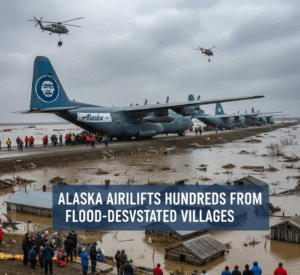
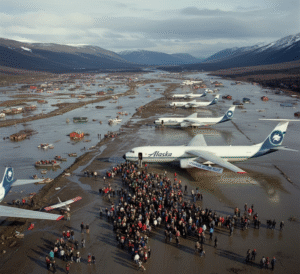
By evening, National Guard helicopters began airlifting the elderly, children, and those in critical condition to the nearby regional hub of Bethel. Others were later moved to Anchorage, where temporary shelters were established. Alaska Airlifts Hundreds from Flood Devastated Villages Alaska airlifts hundreds, Alaska flooding evacuation, Kipnuk flooding, Kwigillingok storm, Alaska storm damage, Typhoon Halong Alaska, Alaska climate crisis, Alaska disaster response.
Kwigillingok: Total Devastation
Kwigillingok, another Indigenous village with roughly 400 residents, faced an equally grim situation. Floodwaters covered nearly the entire settlement, sweeping away vehicles, storage tanks, and sections of boardwalks that serve as the community’s lifeline.
One fatality has been confirmed, while several residents remain missing. Local emergency workers reported that almost every home in Kwigillingok suffered structural damage. Power lines collapsed, and the water and sanitation systems failed completely.
Residents sought refuge in the local school building, which temporarily served as both shelter and command post. Emergency teams described heartbreaking scenes of parents clutching their children while waiting for rescue aircraft to arrive in fierce winds and freezing rain.
The Airlift Operation: A Race Against Time
The Alaska National Guard coordinated with federal and state emergency services to deploy cargo planes and helicopters for rapid evacuations.
-
C-17 transport aircraft were used to move hundreds of evacuees from Bethel to Anchorage in just a few hours.
-
Helicopter teams made repeated trips through challenging weather conditions to rescue stranded families.
-
Local volunteers and tribal councils helped organize check-ins, prioritize vulnerable individuals, and manage shelter logistics.
Despite heroic efforts, rescuers faced severe challenges. Many airstrips were flooded, visibility dropped to near zero at times, and fuel shortages complicated logistics. Communication networks were down for more than a day in some areas, making coordination extremely difficult.
Officials described the operation as a “miracle under pressure,” crediting coordination among the National Guard, Alaska State Troopers, and community leaders for preventing a much higher death toll.
Humanitarian Aftermath
With hundreds displaced, the humanitarian situation remains fragile. Many evacuees arrived in Anchorage with only the clothes on their backs. Shelters provided food, medical care, and psychological support, but long-term housing remains uncertain.
Officials have confirmed that some families may not be able to return home for months, and others might need permanent relocation. Damaged fuel tanks, contaminated water, and eroded land have made entire sections of both Kipnuk and Kwigillingok unsafe.
Relief organizations have mobilized to distribute blankets, heaters, and food. Local communities across Alaska have opened donation drives and volunteer programs to assist those affected.
Infrastructure Collapse and Federal Response
The storm exposed the critical lack of resilient infrastructure in Alaska’s remote coastal regions. Many villages rely on wooden boardwalks, single airstrips, and diesel generators, all of which were severely damaged.
The Alaska Department of Transportation has begun rapid assessments, while the Federal Emergency Management Agency (FEMA) and state emergency offices have pledged funds for rebuilding. However, logistical and bureaucratic hurdles mean that reconstruction could take years.
State officials emphasized that rebuilding will prioritize climate-resilient infrastructure—elevated housing, improved drainage, and reinforced riverbanks—to prevent future disasters.
Climate Change and the Widening Risk
Meteorologists and climate scientists have warned for years that Alaska is warming faster than any other U.S. state, with sea ice retreat and permafrost thaw increasing storm exposure. The latest floods are a direct consequence of these warming trends.
Communities that were once protected by thick coastal ice now face open water during storm season, allowing stronger waves and surges to reach inland. Melting permafrost weakens foundations, meaning homes can shift or sink even without floodwaters.
Experts believe that without urgent investment in adaptation and relocation planning, disasters like this will become routine rather than rare.
Indigenous Communities on the Frontline
The tragedy in Kipnuk and Kwigillingok is also a story of Indigenous resilience. For generations, Alaska Native communities have adapted to harsh environments through deep environmental knowledge and strong social bonds. Yet modern climate impacts are testing even these traditions.
Local elders warn that relocation could threaten cultural heritage, community cohesion, and traditional subsistence practices like fishing and hunting. Many residents are calling for federal aid that not only rebuilds homes but also respects local ways of life.
Tribal councils across Alaska are now advocating for sovereign-led disaster planning, ensuring Indigenous voices lead decisions about where and how to rebuild. Alaska Airlifts Hundreds from Flood Devastated Villages Alaska airlifts hundreds, Alaska flooding evacuation, Kipnuk flooding, Kwigillingok storm, Alaska storm damage, Typhoon Halong Alaska, Alaska climate crisis, Alaska disaster response.
Government & Recovery Efforts
Governor Mike Dunleavy declared a statewide disaster emergency, authorizing funds for rescue, recovery, and housing. The federal government is expected to declare a major disaster, unlocking FEMA support for long-term rebuilding.
The U.S. Army Corps of Engineers has been dispatched to assess erosion and provide technical support for reconstruction. Alaska’s congressional delegation is pushing for emergency climate adaptation funds in upcoming federal budgets.
Meanwhile, community volunteers in Anchorage continue to coordinate clothing drives, mental health support, and temporary school enrollment for displaced children.
Looking Ahead: Lessons from the Floods
This disaster has revealed a painful truth—Alaska’s remote communities are on the frontlines of a changing climate, yet they remain under-funded, under-connected, and under-protected.
Experts are calling for a three-pronged approach:
-
Infrastructure Reinforcement: Build elevated homes, improve flood barriers, and modernize power systems.
-
Early Warning & Response Systems: Expand communication and weather tracking for remote areas.
-
Community-Led Planning: Prioritize Indigenous knowledge and ensure rebuilding efforts align with cultural needs.
The coming months will test Alaska’s resilience and its ability to balance emergency recovery with long-term sustainability. What happens in Kipnuk and Kwigillingok may set the precedent for climate response across the Arctic.
Conclusion
As helicopters continue to ferry evacuees to safety, the full scale of Alaska’s flood disaster is still unfolding. Hundreds have lost their homes, livelihoods, and sense of security—but not their resolve. The storm has become a stark reminder of nature’s power and the urgent need for climate preparedness in America’s northernmost state.
The airlift operation stands as a symbol of hope and unity, showing that in the harshest conditions, Alaskans stand together. Yet it also serves as a warning: if the world does not act swiftly on climate resilience, more communities may face the same fate.